Domaine Henri Gouges — the wines we carry
8 bottles
After the First World War, Henri Gouges inherited nine hectares of vineyards from his father and established the domaine in 1925. Alongside figures like the Marquis d'Angerville and Armand Rousseau, he founded the INAO to eradicate the subpar Burgundy wines that were widespread at the time. When delineating appellations and classifications, to avoid any accusation of favoritism towards Nuits-Saint-Georges and Volnay—where their vineyards were located—they chose not to designate any Grand Cru sites. The domaine was subsequently managed by Henri's grandsons, Pierre and Christian, who oversaw the vineyards and winemaking respectively. Following their retirements, Pierre's son, Grégory, now leads the estate, crafting wines exclusively from a 15-hectare holding in Nuits-Saint-Georges.
In the steep vineyards of the Côte d'Or, soil erosion after heavy rainfall has historically been a persistent challenge. To combat this, Pierre pioneered a method in 1975 of planting grass between the rows of vines. This not only prevented post-rain soil erosion but also served to suppress weed growth. Furthermore, by preventing tall weeds, this practice improved vineyard ventilation and helped inhibit mold development. Additionally, the presence of turf forced the vines' roots to grow downward rather than laterally, enabling them to absorb deep-soil nutrients and, consequently, to express the terroir with greater precision. The vineyards have also been progressively converted to organic farming, achieving 100% organic status by 2008.
The grapes, meticulously harvested and sorted in the vineyards, undergo rigorous secondary sorting on the sorting table located on the second floor of the winery, which was newly built in 2007. To prevent excessive tannin extraction, they are 100% destemmed without crushing using a specialized destemmer, and then transported by gravity to the fermentation tanks on the ground floor. The concrete tanks used for alcoholic fermentation are older vessels dating back to the era of Henri Gouges. Because these are closed vats rather than open-top fermenters, the carbon dioxide generated during alcoholic fermentation is easily retained within the tank. This allows the fermentation process to proceed slowly, drawing out color and aromas from the grapes with utmost care.
Punching down (pigeage) is performed using a mesh-like mechanical system installed within the tank, increasing contact between the juice and the grape skins and seeds—which are pushed upward by the gas—to extract rich aromas and tannins. The wine is then transferred to oak barrels with an approximately 20% new oak ratio to undergo malolactic fermentation and is aged for 18 months. Because the harvested grapes are of exceptionally pristine quality, the resulting wine possesses a natural clarity; thus, it is bottled without fining or filtration. Domaine Finesse materials
What is listed here is only a part of our cellar. Ask us for a particular vintage — we are often able to source it.
 2020 Henri Gouges / Bourgogne Pinot Blanc (France, Burgundy, White)¥8,800
 2019 Henri Gouges / Bourgogne Pinot Blanc (France, Burgundy, White)¥8,800
 2021 Henri Gouges / Bourgogne Pinot Blanc (France, Burgundy, White)¥8,800
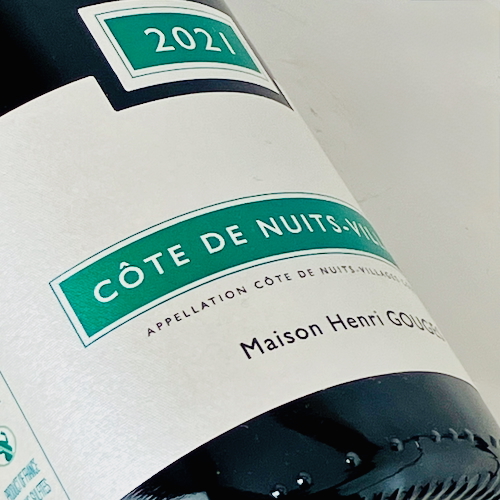 2021 Côte de Nuits Villages / Maison Henri Gouges (France, Burgundy, Red)¥9,900
 2021 Nuits-Saint-Georges / Maison Henri Gouges (France, Burgundy, Red)¥14,300
 2020 Henri Gouges / Nuits-Saint-Georges 1er Cru Les Pruliers (France, Burgundy, Red)¥24,200
 2018 Henri Gouges / Nuits-Saint-Georges 1er Cru Les Pruliers (France, Burgundy, Red)¥29,700
 2021 Nuits-Saint-Georges 1er Cru La Perrières / Domaine Henri Gouges (France, Burgundy, White)¥31,900